

Near Field Communication (NFC) refers to a short-range wireless connectivity technology that enables devices to exchange data when brought within a few centimeters of each other. Operating at a frequency of 13.56 MHz, NFC simplifies data transfer, access control, and wireless configuration, eliminating the need for complex manual pairing or external power sources in passive tags.
| Feature | NFC (Near Field Communication) | RFID (Radio Frequency Identification) | Conventional Wireless (e.g., Bluetooth) |
|---|---|---|---|
| Operating Range | Ultra-short range (< 4 cm) | Long range (up to 100m depending on frequency) | Medium to Long range (up to 10m – 100m) |
| Communication | Two-way (Read/Write & Peer-to-Peer) | One-way (Reader transmits, Tag responds) | Two-way (Peer-to-Peer data sync) |
| Setup Time | Instant (< 0.1 second) | Instant (< 0.1 second) | Longer due to manual pairing/discovery |
| Power Requirement | Supports passive tags (no battery required) | Supports passive tags (no battery required) | Active power required on both devices |
| Security Level | Extremely high (due to proximity restrictions) | Lower (susceptible to long-range skimming) | Moderate (encrypted but prone to remote hacking) |
| Primary Use Cases | Smart lighting config, secure access, mobile payments | Logistics, inventory tracking, toll collection | Wireless audio, continuous data streaming |
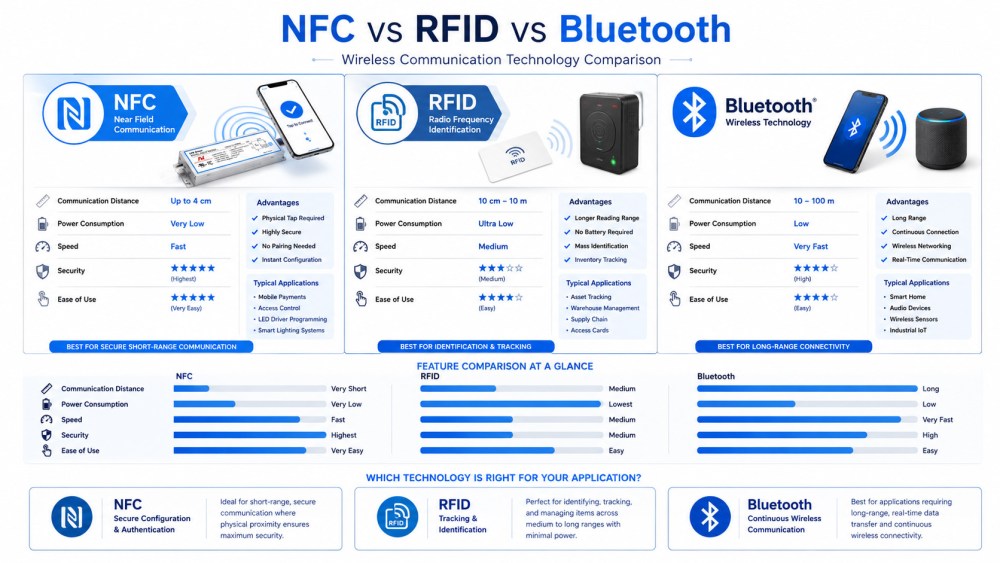
This makes NFC technology exceptionally suitable for industrial automation, smart lighting configuration, and secure access systems where deployment efficiency and reliability are critical.
How NFC Technology Works
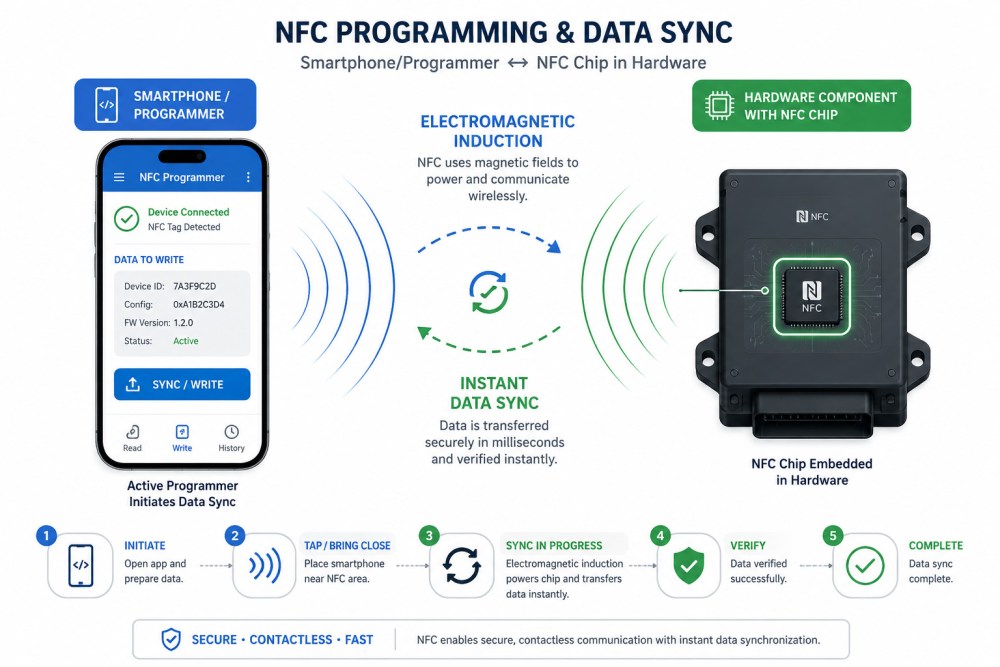
An NFC-enabled system operates through electromagnetic field induction between two loop antennas. The mechanism is designed with a seamless communication structure that:
- Generates an RF Field: The active device (initiator/reader) emits a 13.56 MHz radio frequency field.
- Powers the Target: When a passive NFC tag enters the field, it is automatically powered via electromagnetic induction (No battery required for the tag).
- Transmits Data Instantly: The reader and target exchange data packets through modulation within milliseconds.
- Eliminates Manual Pairing: Unlike Bluetooth, it bypasses authorization passwords, making system adjustments and asset tracking completely plug-and-play.
Key Benefits of NFC Integration
- Rapid On-Site Configuration
No manual wiring or complex software setups are required. Technicians can configure device parameters instantly on-site via an NFC smartphone app, significantly reducing commissioning time.
- Battery-Free Operations
Passive NFC tags can store crucial asset data, batch codes, and custom parameters permanently without requiring any internal battery, lowering overall system maintenance and hardware costs.
- Enhanced Reliability & Security
Because devices must be virtually touching to communicate, NFC inherently prevents accidental cross-talk, signal interference, and remote hacking attempts in crowded industrial environments.
NFC technology is widely utilized across various modern industries, expanding far beyond just mobile payments into commercial and industrial hardware ecosystems:
- Smart Lighting Systems & LED Drivers (Customizing output currents and dimming profiles wirelessly)
- Warehouse & Inventory Asset Tracking (Maintenance logging and automatic model identification)
- Industrial Automation & Sensor Calibration (Adjusting field equipment parameters without opening sealed enclosures)
- Commercial Access Control & Facility Management (Secure building entry and credential verification)
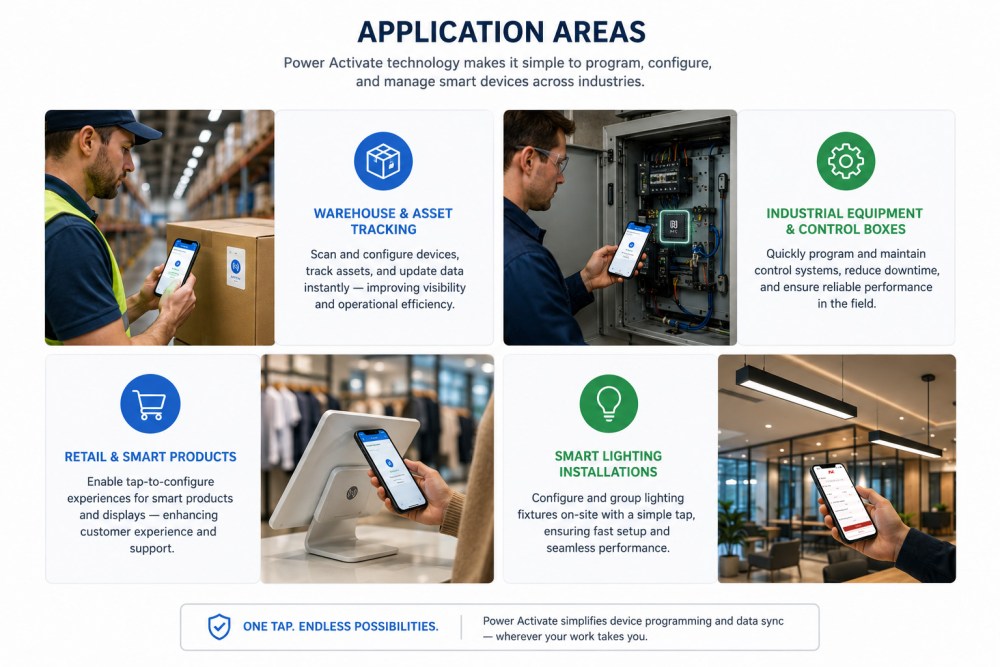
These industrial and commercial environments benefit immensely from wireless, non-powered data transmission and reduced configuration errors during field installation.