1. What is an Emergency Lighting Inverter?
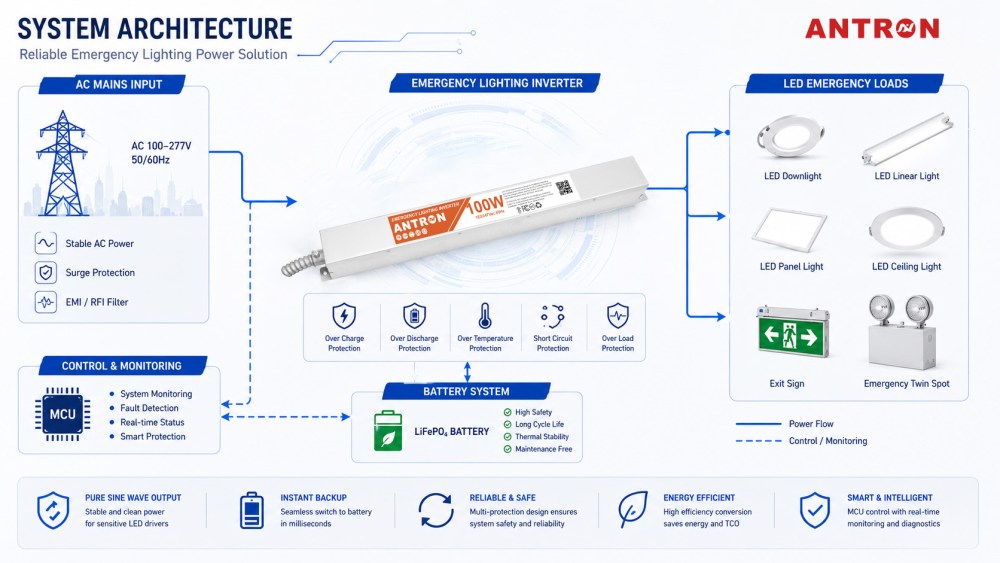
An Emergency Lighting Inverter (often classified as a mini-inverter system) is a centralized, stand-alone backup power supply engineered to maintain the uninterrupted operation of standard architectural light fixtures during a utility grid failure.
Unlike individual emergency battery packs (EMBs) installed inside every luminaire, a central emergency inverter supplies AC power directly to multiple designated branch circuits. This specialized infrastructure allows ordinary interior and exterior fixtures to function identically as emergency egress lighting, delivering 100% full lumen output for the legally mandated duration without requiring redundant or specialized wiring.
2. Core Engineering Advantages: Pure Sine Wave Technology
Antron Emergency Lighting Inverters are designed to support complex, high-efficiency commercial solid-state lighting (SSL) loads through advanced electronic architecture:
Pure Sine Wave Output: Delivers clean, continuous sinusoidal power ( to ) that replicates standard utility grids. This prevents harmonic distortion and technical degradation in sensitive LED AC drivers, multi-zone sensors, and emergency control relays.
Universal Voltage Versatility: Dynamically handles input/output configurations across standard commercial lines, operating seamlessly within 120-277V (50/60Hz) systems.
Microprocessor-Driven Automatic Transfer Switch (ATS): Incorporates high-speed solid-state switching that senses grid anomalies and routes power from the internal battery array to the inverter module within milliseconds, avoiding any flicker or ignition delay in high-intensity discharge or LED structures.
3. Technical Specifications & Compliance Matrix
| Technical Parameter Dimension | System Specification Details | Project Engineering Value |
|---|---|---|
| Output Waveform Profile | Pure Sine Wave (True Sinusoidal) | Eliminates electrical hum and ensures 100% compatibility with all AC drivers. |
| Voltage Configuration | Universal 120VAC / 277VAC (50/60 Hz) | Standardized deployment across diverse commercial and industrial building grids. |
| Efficiency Rating | High-efficiency DC-to-AC Inversion Module | Minimizes internal thermal load and extends electronic lifecycle. |
| Battery Chemistry | Advanced Premium LiFePO4 / Sealed VRLA Options | High thermal stability, environment-friendly, and prolonged trickle-charge life. |
| Emergency Runtime | Minimum 90 Minutes (Full Rated Load) | Fully satisfies and exceeds UL 924 and NFPA 101 Life Safety Code mandates. |
| Regulatory Certifications | UL 924 Listed, BC Certified, CEC Title 20 Compliant | Ensures smooth inspector sign-offs and local government energy rebate alignment. |
4. Simplified Maintenance & System Diagnostics
To guarantee absolute readiness for critical fire and safety walkthroughs, every Antron Emergency Inverter system features:
Intelligent Self-Diagnostic Cycle: The internal control board automates mandatory periodic testing (monthly short-term functional tests and annual full-discharge duration verification) without requiring manual on-site execution.
Real-Time LED Status Array: Displays immediate diagnostic tracking (charging status, battery capacity depletion, inverter load conditions), pinpointing potential anomalies instantly from ground level.
Robust Circuit Protections: Built-in safeguards including input surge insulation, output short-circuit isolation, over-voltage clipping, and thermal shutdown to prevent field wiring faults from disrupting the main backup infrastructure.
Core Structural Applications
High-Ceiling Warehouses & Industrial Logistic Hubs (UFO High-Bays, Vapor-Tights)
Commercial Office Towers & Mixed-Use Shopping Facilities (Linear Slots, Troffers)
Educational and Institutional Campuses (Auditoriums, Hallways, Exit Paths)
Outdoor Architectural and Perimeter Egress Areas (Wall Packs, Floodlights)